
Rebuilt this site — with Claude Code for 10 USD
Last year I migrated the site to Next.js. Now it runs on Astro — and this time most of the work was done by Claude Code. For about 10 USD in tokens.
- #it
- #astro
- #ai
Personal blog — some kind of knowledge store.
Last year I migrated the site to Next.js. Now it runs on Astro — and this time most of the work was done by Claude Code. For about 10 USD in tokens.
From the outside only the most important services should be reachable. The others are protected by Traefik. Authentik also serves as the identity provider for SSO.
Besides developing all kinds of things, I enjoy playing puzzle games like the EXIT series and live adventures like escape rooms with friends

An advanced GeoCache is to be built. It is intended to illustrate the evolution of data transmission.
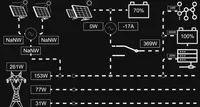
Home Assistant has a very useful overview page for energy flows. There is a power overview as a community plugin for Lovelace Card. This is suitable for many setups, but mine is a bit more complex.
For several months, my Wi-Fi has been incredibly slow. Over WiFi, I get speed test results equivalent to a connection from 15 years ago. Even YouTube has problems. We're talking about 5-10Mbit/s over Wi-Fi

For years, actually decades, I've maintained a website, primarily an overview of all my projects. I now want a new site. Reproducible, static, minimalist, simple.
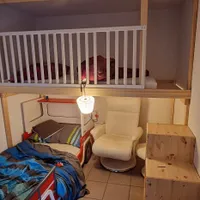
The children's room is rather small. With a second bed in standard size, it would have become very cramped. So I needed a solution. To gain space, I built a bunk bed. The existing bed serves as the lower bunk. The rails from the old IKEA toddler bed were reused. The entire bed is anchored to the wall with 2 screws and is self-supporting.

The fan in my bathroom (certified 1989) once had a time delay function, but it was not correctly connected. Not sure it this was made because it didn't work anymore. Additionally, the wire that was supposed to carry constant voltage wasn't even connected behind the mirror cabinet...
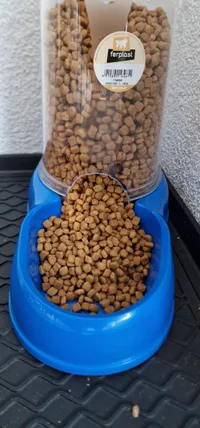
I found an inexpensive food/water dispenser, but it didn't work. The hole was cut very deep (it has to be, otherwise the water would leak out) and this hindered the dry food flow so much that the bowl remained empty by cat standards.
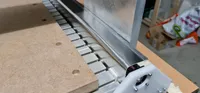
After the gantry, the groove plate were installed and the Z-axis was back on, the first improvements were made. Here is the dust protection for the KUS.

For Christmas, we like to give handcrafted gifts made by our children to their godparents. In spring 2021, both were fascinated by the birds on our terrace, and they always enjoy painting. That's when the idea emerged to mill birdhouse kits with the CNC, which the children could then paint.
Finally completed an old project. The edge where the paving stones meet the wall had been filled with gravel for a year, which looked mediocre but worked. However, the children kept playing with the gravel, and visually it bothered me long enough. Measure, draw, cut, and then lay. I cut with a cheap angle grinder and a diamond blade, which works like cutting through butter.
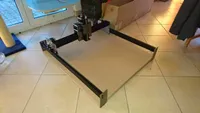
This second CNC was a kit, a Shapeoko from [myhobby-cnc](https://shop.myhobby-cnc.de/bausaetze/fraesen/6/shapeoko2-kit?c=12).
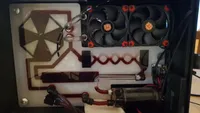
An Intel I5 6600k, GTX1070, a bit of RAM... nothing special. Except that the PC is built into a suitcase. And water-cooled. And most of the water channels are milled. And the PC can be clamped to the tabletop in an elevated position.
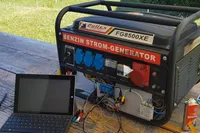
As part of the power supply concept for servers etc., I extended a generator with electric start. Originally it's an ordinary generator with a manual cold start lever and a pull cord. Additionally, it now has a key switch to operate the electric starter. The cold start remains manual. An Arduino now handles the entire starting process.
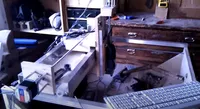
About 15 years ago, I built my first CNC. It consisted almost exclusively of materials from the hardware store. I found the stepper set with driver board for the LTP parallel port on eBay. AliExpress wasn't known back then.
At a motocross event, I once saw a professional drone, an octocopter. Research revealed that these were virtually unaffordable... So I immediately ordered motors and accessories from dx.com and started programming...
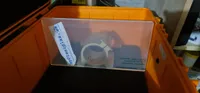
Today the first raw materials arrived. Acrylic plates, already cut to size and polished. One 5mm and one 10mm plate will form a platform. Now I can start drawing. Actually, I could have started already... But I have time and would prefer to use iterative rapid prototyping rather than planning forever and then building according to blueprints.
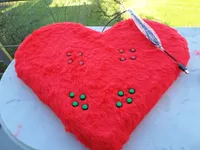
A couple of friends announced their upcoming wedding. Both are gamers, so what would be a good gift? A heart-shaped gamepad for two!
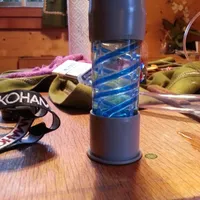
Without many words, here are a few iterations of the T-Virus and antidote from Resident Evil which I used for my old cosplay.
To map the various PCs and systems to the different screens, I acquired an Aten 4x4 4k HDMI matrix online. Affordable as it was a customer return.
To be able to open both garage doors via OpenHAB, I use a 2-relay board with an ESP01 on it.

When a reverse proxy is used, it typically also handles the encryption/decryption of HTTPS-HTTP. This means that WordPress, in my case the Docker image, is accessed via HTTP and consequently returns all links via HTTP.
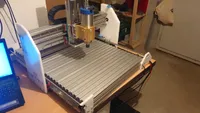
The work surface, the slotted plate segments, I screwed onto the frame using slot nuts and M6 hex screws, as these screws fit exactly into the slots.
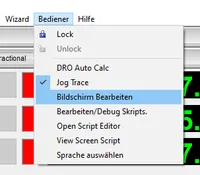
If softlimits are defined in Mach4, they have to be reactivated every time. But this could be done automatically after homing... Here’s how.
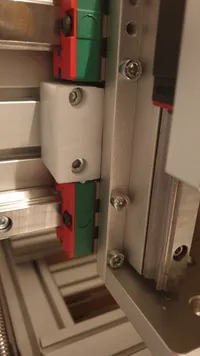
Due to my relocation, I gave away my Shapeoko earlier than planned. So I didn't get to mill the loose bearings. I actually thought I would make up for this first with the CNC MK3. However, the loose ends of the KUS swing up too quickly, which is why I quickly made provisional loose bearings from scrap.
After driving the first meters yesterday, I consider the side walls (portal cheeks) a success. But the POM-C is too soft after all. I originally thought that 22mm would be stable enough, but the servos bend the cheeks effortlessly. I discovered this when I had swapped the plugs of the servo controls, causing the X-axis to try homing at the Y-axis end stop.
Shortly before finishing work, I wanted to examine the delivery from Motedis.ch. Since the length of the CNC is adapted to the standard lengths of the AliExpress-KUS, a continuous work surface cannot be created with the standard profiles. There remains a 20mm gap that I somehow still need to close.